April 28, 2026
Asymmetric integration and hybrid governance in the Iranian videogame industry
For many Iranian players, the global video game industry was never entered through a storefront. It arrived through copied discs, cracked installers, Telegram links, foreign accounts and payment routes that had to be borrowed, bypassed or disguised. Only from the outside does this look like delay. From within, it is a different architecture of access.
Treating the global industry as a single bloc carries a hidden cost. It imposes yardsticks shaped in Western markets onto ecosystems that have never moved along the same coordinates, and turns every divergence into a sign of backwardness. What looks like lag is often the visible surface of a different history, written under different constraints. Those constraints are rarely only political. They are also infrastructural, regulatory and monetary. Which storefronts you can reach, which payment rails will clear your transaction, which engine licenses you can sign, which platform governance frameworks count you as a legitimate complementor. Steam, Epic, the App Store, Unity and Unreal, Visa and Mastercard. Each is a node where Iranian users, developers and regulators meet rules they did not write.
Iran is one of the clearest cases in which the single bloc lens fails. To read it as delay is to misread it. The country reveals decades of distinct political, social, regulatory and technological sediments. The result is not a marginal industry, nor an incomplete one. It is an industry shaped by a subordinate integration into digital globalization, in which informal consumption, sanctions, dependence on foreign platforms, and state governance of the ecosystem do not alternate but coexist as layers of the same structure.
The Iranian specificity
Restriction in Iran did not produce closure alone. As often happens, it also fed hidden forms of consumption. When that consumption belongs fully to the realm of leisure, the strategies devised to bypass obstacles cease to be marginal exceptions. They become concrete, creative and socially embedded practices. It has generated a distinctive capacity for adaptation, an informal market of considerable depth, dedicated institutions and hybrid forms of governance that resist any straightforward reading.
The story begins in 1979. After the revolution, controls on Western cultural products multiplied, and informal consumption became the rule. Cinema and music moved first. Video games followed, occupying a substantial share of the shadow market and turning piracy from a practice into an infrastructure. Disc shops, copy networks, cracked installers, then mirror sites and Telegram channels. Each step doubled as a distribution layer, performing the functions of a marketplace and of a discovery surface without naming itself as such. What emerged was not only an autonomous economic circuit but a stable regime of access, through which Iranian audiences cultivated skills, tastes and expectations already oriented toward the global market (1).
The local scene took shape in the late 1990s, inside this regime. The first developers did not come from an established industry, nor from specialised training pipelines. They came from amateur circles, university labs, semi-informal workshops, where video games appeared at once as creative practice, technical experiment and point of access to a sector in expansion. The difficulty they faced was structural before it was economic. Local studios were trying to occupy a symbolic and commercial space already saturated by foreign blockbusters circulated through piracy networks, and therefore available at marginal cost. They were also entering a production stack designed for someone else. Engine licensing terms, asset stores, online services and storefronts that assumed a developer with a Western billing address, a clearable payment method and a sanctioned-friendly nationality. Any reading that frames the emergence of Iranian development as an autonomous and linear trajectory misses this asymmetry at the root.
By the time a local industry began to consolidate, the market was already culturally oriented toward global production. Foreign titles, widely circulated through informal channels, had trained players' tastes, expectations and technical literacy. This familiarity gave Iranian developers an audience already fluent in the language of games. It also placed them in direct competition with global blockbusters available at minimal cost. To this asymmetry, the state added a further layer of fragility. Restrictions on violence and sexuality narrowed the creative field. International sanctions and dependence on foreign technological infrastructures complicated access to major development toolchains, digital storefronts and payment rails required for international distribution. The dependency is platform specific and uneven. Unity and Unreal as the tooling oligopoly, Steam and Epic as the distribution gates, Apple and Google as the mobile bottleneck, Visa and Mastercard as the silent first filter. Each is a private governance system with its own opaque rules, applied to Iranian developers under the additional weight of Treasury and OFAC sanctions. The outcome was a condition of permanent adaptation inside a system of subordinate interdependence, in which using Unity or Unreal, or publishing on transnational marketplaces, sometimes required circumventing the very rules imposed at home (2).
Faced with clandestine practices on this scale, Tehran did not choose suppression. It chose administration, and built a governance model unlike those adopted elsewhere. From 2007 onward, the first dedicated institutions appeared. The Iran Computer and Video Games Foundation (3), and the Entertainment Software Rating Association, the latter operating through a classification system openly rooted in moral and religious criteria (4). Alongside them, the Digital Games Research Center acted as the analytical arm of the Foundation, producing data on the sector (5). These bodies were tasked with supporting, classifying, monitoring and steering the local industry. The intervention of the state, however, did not aim to extinguish informality. It aimed to channel it. The clearest example is the holographic label affixed to pirated copies of Western games, a device that does not suppress the parallel market but makes it governable, conditioning its circulation on the prior sale of a quota of Iranian titles. The mechanism is worth pausing on. It is not Iran emulating Steam or the App Store. It is Iran inventing, on the back of a vernacular distribution network, a hybrid storefront governance. A state agency setting cross subsidy rules between foreign and domestic content over a marketplace it neither owns nor formally recognises.
The global shift toward live service games has gradually unsettled this equilibrium. Where informal access once allowed a broad public to encounter the major Western titles on roughly equal footing, the rising centrality of permanent connectivity, authenticated copies and international payment circuits has made that access far more selective. Live service is not merely an evolution of the product. It is a different commodity form. The game ceases to be a self contained object that piracy can capture once and for all, and becomes a continuously updated, server bound, account bound stream of content, monetised through battle passes, microtransactions and event windows that the parallel market cannot easily reroute. The Iranian shadow infrastructure was efficient against discs and installers. It is structurally outmatched by an architecture in which the playable artefact lives on someone else's servers and only opens for a verified payment. Accessing the latest titles increasingly depends on Western credit cards and on material resources unevenly distributed across the population. A new social line has opened, one in which access to live services tends to coincide with urban and cosmopolitan privilege. Dependence on global infrastructures, in this sense, does not merely limit local production. It redraws internal hierarchies of class and consumption, redefining in less visible ways who plays what, and on which terms.
Hostile narratives, discursive responsibility, and independent niches
If on the industrial plane Iran is a structural exception, on the narrative plane it is in far more familiar company. Like Russia, it has long been exposed to hostile representations of its territory and of Islam, circulated through some of the most successful Western productions of the last two decades, and circulated at scale precisely through the same global storefronts and online services that Iranian players struggle to access on equal terms.
Battlefield 3 is perhaps the cleanest example. The player moves as a US soldier through the streets of Tehran, reduced to the scenery of a high intensity firefight inside a storyline built around the neutralisation of the Iranian nuclear threat (6). Call of Duty Modern Warfare 2 works along adjacent lines. Its narrative arc includes terrorist scenarios peopled by characters with Iranian names and Persian accents, reinforcing an imaginary in which Iranian identity is bent into the shape of political violence and jihadism (7). These are not marginal titles. They are global blockbusters, played by tens of millions, and they have contributed, over time, to a representation of the country that precedes any diplomatic file.
Tehran has read this recurrence as a problem of discursive responsibility, the perceived need to answer on the same terrain on which one is being represented. From this posture emerged a series of counter narrative products. Special Operation 85 Hostage Rescue, released in 2007, is a shooter produced within religious student circles in Isfahan (8), in which the player leads a commando unit tasked with freeing two Iranian nuclear scientists kidnapped by US and Israeli forces during a pilgrimage to Karbala. More recently, following the Iranian operation of April 2024 known to domestic media as True Promise, information channels reported the development of a video game titled Vade Sadegh, or True Promise. Iran International (9) cited statements attributed to an official linked to the Ministry of Defense, according to whom the product had been designed for a young public, with references to scenarios and weapons systems drawn from the operational experience of the Israel Hamas war. The function of such a title is primarily domestic. Legitimise, memorialise, translate a military operation into the grammar young audiences already read fluently.
The relationship between Iran and video games, however, is not exhausted by political or military shooters. It also passes through the quieter channel of those who try to present the deeper culture of the country to a global audience whose perception of Iran is shaped by orientalism and decades of geopolitical confrontation. An indie niche has formed around Iranian developers who, reportedly in friction with the regime, operate beyond the country's borders. The Tales of Bistun is one of its most interesting products. A work of Iranian youth on Persian mythology and historical tradition, striking aesthetically and substantively. The game places unusual emphasis on the pre Islamic religious dimension of Zoroastrianism, once among the most widespread belief systems in the region, emblematic of a segment of Iranian society now reduced in numbers yet historically foundational, at times marginalised by the Shiite mainstream. The title is not classified as state funded, and belongs firmly to the independent production circuit. The studio behind it, Black Cube Games, is based in the Netherlands. The game was released through a European publisher, IMGN.PRO, headquartered in Poland, and distributed on Steam and the Epic Games Store.
Bistun is important precisely because it carries no narrative serviceable to the regime. It foregrounds a historically significant minority, rooted in a religious tradition and a civilisational arc that predate the rise of Islam in the Indo Iranian space. It reminds the reader that Iranian cultural production, when it manages to step outside the political gravitation of the republic, can speak of itself in registers the official narrative does not concede. What the case also makes legible, in platform terms, is the precise architecture of that exit. To reach a global audience, an Iranian creative project has to relocate the entire production chain into compatible jurisdictions. A studio incorporated in the Netherlands, a publisher seated in Poland, distribution agreements with Valve and Epic, payment processing routed through Western banks. The cultural step out of the republic and the infrastructural step into the global platform stack are the same step. Bistun does not only escape Iranian narrative. It qualifies, in legal, financial and platform terms, as a non Iranian product. The price of speaking, here, is nationality on paper.
The Iranian case is not only about adaptation and constraint. It works as a sensor, picking up the frictions between domestic governance, global technological interdependence, and the political and religious fractures of Iranian society. Those fractures, sharpened by years of anti regime contestation, are visible even on a screen, for those who know where to look. The case holds only if read on three planes at once. The strategic geometry of sanctions and ideological state. The lived microtexture of arcade shops, religious student studios and diaspora indies. The platform political economy of engines, storefronts, payment networks and live service architectures, which is where, more often than not, the decisive friction now sits.
Sources
1: M. Daiiani and B. Keogh, “An Iranian videogame industry? Localizing videogame production beyond the ‘global’ videogame industry,” Media Industries, vol. 9, no. 1, 2022. doi:10.3998/mij.89.
2: A. Garst, “Video game development in Iran: Limited tools, front companies and a specter of war,” The Washington Post, Feb. 5, 2020
3: Iran Computer and Video Games Foundation, “About,” accessed Dec. 6, 2025.
4: S. Piasecki, “ESRA, the Iranian games age rating system,” Heidelberg Journal of Religions on the Internet, vol. 11, pp. 1–22, 2016. doi.org/10.17885/heiup.rel.2016.0.23632
5: Digital Games Research Center (DIREC) [مرکز تحقیقات بازیهای دیجیتال (دایرک)]. (s.d.). About Us
6: J. Höglund, “Electronic empire: Orientalism revisited in the military shooter,” Game Studies, vol. 8, no. 1, 2008.
7: M. M. Mohammed and K. H. Addai, “Politics in video games: A socio-cognitive analysis of Call of Duty: Modern Warfare 2 and Battlefield 3,” Kufa Journal of Arts, vol. 1, no. 62, pp. 359–382, 2024 doi:10.36317/kaj/2023/v1.i57.12156.
8: M. Daiiani and B. Keogh, “An Iranian videogame industry.
9: Iran International, “Defense Ministry official: We made the ‘Vade Sadegh’ game for children,” Feb. 4, 2025
10: Ghorbanpour, K., & Prax, P. (2024, August 22). Seyyed of Cyrus the Great: Iran’s Confused Nationalism in Games. Transactions of the Digital Games Research Association, 7(1), 127–156. https://doi.org/10.26503/todigra.v7i1.2185
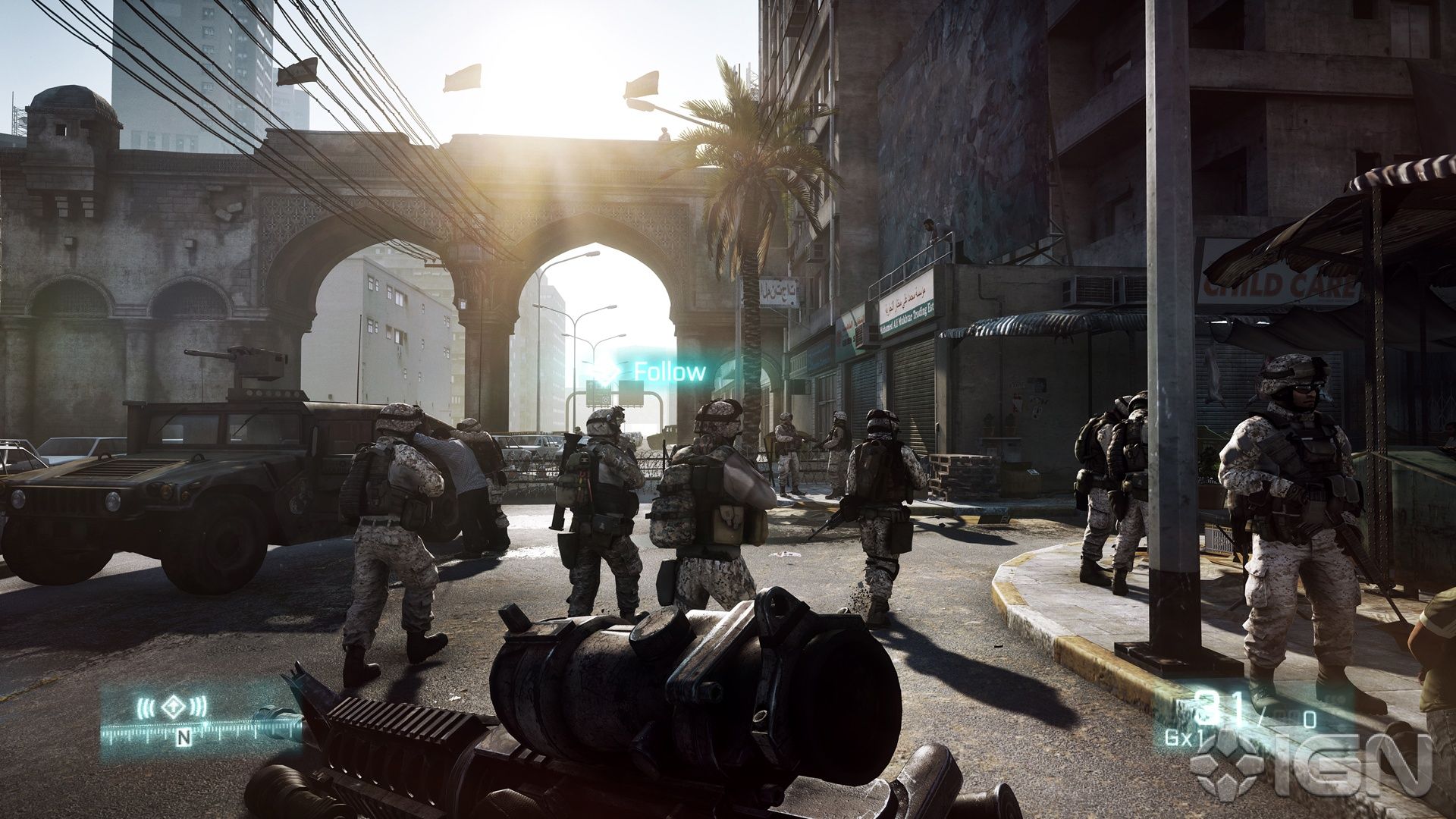
Imagine - DICE / Electronic Arts, Battlefield 3, official promotional screenshot from the video game, 2011, EA official gallery, urban scene depicting a Marine patrol and military vehicles in the urban setting of Tehran.
For many Iranian players, the global video game industry was never entered through a storefront. It arrived through copied discs, cracked installers, Telegram links, foreign accounts and payment routes that had to be borrowed, bypassed or disguised. Only from the outside does this look like delay. From within, it is a different architecture of access.
Treating the global industry as a single bloc carries a hidden cost. It imposes yardsticks shaped in Western markets onto ecosystems that have never moved along the same coordinates, and turns every divergence into a sign of backwardness. What looks like lag is often the visible surface of a different history, written under different constraints. Those constraints are rarely only political. They are also infrastructural, regulatory and monetary. Which storefronts you can reach, which payment rails will clear your transaction, which engine licenses you can sign, which platform governance frameworks count you as a legitimate complementor. Steam, Epic, the App Store, Unity and Unreal, Visa and Mastercard. Each is a node where Iranian users, developers and regulators meet rules they did not write.
Iran is one of the clearest cases in which the single bloc lens fails. To read it as delay is to misread it. The country reveals decades of distinct political, social, regulatory and technological sediments. The result is not a marginal industry, nor an incomplete one. It is an industry shaped by a subordinate integration into digital globalization, in which informal consumption, sanctions, dependence on foreign platforms, and state governance of the ecosystem do not alternate but coexist as layers of the same structure.
The Iranian specificity
Restriction in Iran did not produce closure alone. As often happens, it also fed hidden forms of consumption. When that consumption belongs fully to the realm of leisure, the strategies devised to bypass obstacles cease to be marginal exceptions. They become concrete, creative and socially embedded practices. It has generated a distinctive capacity for adaptation, an informal market of considerable depth, dedicated institutions and hybrid forms of governance that resist any straightforward reading.
The story begins in 1979. After the revolution, controls on Western cultural products multiplied, and informal consumption became the rule. Cinema and music moved first. Video games followed, occupying a substantial share of the shadow market and turning piracy from a practice into an infrastructure. Disc shops, copy networks, cracked installers, then mirror sites and Telegram channels. Each step doubled as a distribution layer, performing the functions of a marketplace and of a discovery surface without naming itself as such. What emerged was not only an autonomous economic circuit but a stable regime of access, through which Iranian audiences cultivated skills, tastes and expectations already oriented toward the global market (1).
The local scene took shape in the late 1990s, inside this regime. The first developers did not come from an established industry, nor from specialised training pipelines. They came from amateur circles, university labs, semi-informal workshops, where video games appeared at once as creative practice, technical experiment and point of access to a sector in expansion. The difficulty they faced was structural before it was economic. Local studios were trying to occupy a symbolic and commercial space already saturated by foreign blockbusters circulated through piracy networks, and therefore available at marginal cost. They were also entering a production stack designed for someone else. Engine licensing terms, asset stores, online services and storefronts that assumed a developer with a Western billing address, a clearable payment method and a sanctioned-friendly nationality. Any reading that frames the emergence of Iranian development as an autonomous and linear trajectory misses this asymmetry at the root.
By the time a local industry began to consolidate, the market was already culturally oriented toward global production. Foreign titles, widely circulated through informal channels, had trained players' tastes, expectations and technical literacy. This familiarity gave Iranian developers an audience already fluent in the language of games. It also placed them in direct competition with global blockbusters available at minimal cost. To this asymmetry, the state added a further layer of fragility. Restrictions on violence and sexuality narrowed the creative field. International sanctions and dependence on foreign technological infrastructures complicated access to major development toolchains, digital storefronts and payment rails required for international distribution. The dependency is platform specific and uneven. Unity and Unreal as the tooling oligopoly, Steam and Epic as the distribution gates, Apple and Google as the mobile bottleneck, Visa and Mastercard as the silent first filter. Each is a private governance system with its own opaque rules, applied to Iranian developers under the additional weight of Treasury and OFAC sanctions. The outcome was a condition of permanent adaptation inside a system of subordinate interdependence, in which using Unity or Unreal, or publishing on transnational marketplaces, sometimes required circumventing the very rules imposed at home (2).
Faced with clandestine practices on this scale, Tehran did not choose suppression. It chose administration, and built a governance model unlike those adopted elsewhere. From 2007 onward, the first dedicated institutions appeared. The Iran Computer and Video Games Foundation (3), and the Entertainment Software Rating Association, the latter operating through a classification system openly rooted in moral and religious criteria (4). Alongside them, the Digital Games Research Center acted as the analytical arm of the Foundation, producing data on the sector (5). These bodies were tasked with supporting, classifying, monitoring and steering the local industry. The intervention of the state, however, did not aim to extinguish informality. It aimed to channel it. The clearest example is the holographic label affixed to pirated copies of Western games, a device that does not suppress the parallel market but makes it governable, conditioning its circulation on the prior sale of a quota of Iranian titles. The mechanism is worth pausing on. It is not Iran emulating Steam or the App Store. It is Iran inventing, on the back of a vernacular distribution network, a hybrid storefront governance. A state agency setting cross subsidy rules between foreign and domestic content over a marketplace it neither owns nor formally recognises.
The global shift toward live service games has gradually unsettled this equilibrium. Where informal access once allowed a broad public to encounter the major Western titles on roughly equal footing, the rising centrality of permanent connectivity, authenticated copies and international payment circuits has made that access far more selective. Live service is not merely an evolution of the product. It is a different commodity form. The game ceases to be a self contained object that piracy can capture once and for all, and becomes a continuously updated, server bound, account bound stream of content, monetised through battle passes, microtransactions and event windows that the parallel market cannot easily reroute. The Iranian shadow infrastructure was efficient against discs and installers. It is structurally outmatched by an architecture in which the playable artefact lives on someone else's servers and only opens for a verified payment. Accessing the latest titles increasingly depends on Western credit cards and on material resources unevenly distributed across the population. A new social line has opened, one in which access to live services tends to coincide with urban and cosmopolitan privilege. Dependence on global infrastructures, in this sense, does not merely limit local production. It redraws internal hierarchies of class and consumption, redefining in less visible ways who plays what, and on which terms.
Hostile narratives, discursive responsibility, and independent niches
If on the industrial plane Iran is a structural exception, on the narrative plane it is in far more familiar company. Like Russia, it has long been exposed to hostile representations of its territory and of Islam, circulated through some of the most successful Western productions of the last two decades, and circulated at scale precisely through the same global storefronts and online services that Iranian players struggle to access on equal terms.
Battlefield 3 is perhaps the cleanest example. The player moves as a US soldier through the streets of Tehran, reduced to the scenery of a high intensity firefight inside a storyline built around the neutralisation of the Iranian nuclear threat (6). Call of Duty Modern Warfare 2 works along adjacent lines. Its narrative arc includes terrorist scenarios peopled by characters with Iranian names and Persian accents, reinforcing an imaginary in which Iranian identity is bent into the shape of political violence and jihadism (7). These are not marginal titles. They are global blockbusters, played by tens of millions, and they have contributed, over time, to a representation of the country that precedes any diplomatic file.
Tehran has read this recurrence as a problem of discursive responsibility, the perceived need to answer on the same terrain on which one is being represented. From this posture emerged a series of counter narrative products. Special Operation 85 Hostage Rescue, released in 2007, is a shooter produced within religious student circles in Isfahan (8), in which the player leads a commando unit tasked with freeing two Iranian nuclear scientists kidnapped by US and Israeli forces during a pilgrimage to Karbala. More recently, following the Iranian operation of April 2024 known to domestic media as True Promise, information channels reported the development of a video game titled Vade Sadegh, or True Promise. Iran International (9) cited statements attributed to an official linked to the Ministry of Defense, according to whom the product had been designed for a young public, with references to scenarios and weapons systems drawn from the operational experience of the Israel Hamas war. The function of such a title is primarily domestic. Legitimise, memorialise, translate a military operation into the grammar young audiences already read fluently.
The relationship between Iran and video games, however, is not exhausted by political or military shooters. It also passes through the quieter channel of those who try to present the deeper culture of the country to a global audience whose perception of Iran is shaped by orientalism and decades of geopolitical confrontation. An indie niche has formed around Iranian developers who, reportedly in friction with the regime, operate beyond the country's borders. The Tales of Bistun is one of its most interesting products. A work of Iranian youth on Persian mythology and historical tradition, striking aesthetically and substantively. The game places unusual emphasis on the pre Islamic religious dimension of Zoroastrianism, once among the most widespread belief systems in the region, emblematic of a segment of Iranian society now reduced in numbers yet historically foundational, at times marginalised by the Shiite mainstream. The title is not classified as state funded, and belongs firmly to the independent production circuit. The studio behind it, Black Cube Games, is based in the Netherlands. The game was released through a European publisher, IMGN.PRO, headquartered in Poland, and distributed on Steam and the Epic Games Store.
Bistun is important precisely because it carries no narrative serviceable to the regime. It foregrounds a historically significant minority, rooted in a religious tradition and a civilisational arc that predate the rise of Islam in the Indo Iranian space. It reminds the reader that Iranian cultural production, when it manages to step outside the political gravitation of the republic, can speak of itself in registers the official narrative does not concede. What the case also makes legible, in platform terms, is the precise architecture of that exit. To reach a global audience, an Iranian creative project has to relocate the entire production chain into compatible jurisdictions. A studio incorporated in the Netherlands, a publisher seated in Poland, distribution agreements with Valve and Epic, payment processing routed through Western banks. The cultural step out of the republic and the infrastructural step into the global platform stack are the same step. Bistun does not only escape Iranian narrative. It qualifies, in legal, financial and platform terms, as a non Iranian product. The price of speaking, here, is nationality on paper.
The Iranian case is not only about adaptation and constraint. It works as a sensor, picking up the frictions between domestic governance, global technological interdependence, and the political and religious fractures of Iranian society. Those fractures, sharpened by years of anti regime contestation, are visible even on a screen, for those who know where to look. The case holds only if read on three planes at once. The strategic geometry of sanctions and ideological state. The lived microtexture of arcade shops, religious student studios and diaspora indies. The platform political economy of engines, storefronts, payment networks and live service architectures, which is where, more often than not, the decisive friction now sits.
Sources
1: M. Daiiani and B. Keogh, “An Iranian videogame industry? Localizing videogame production beyond the ‘global’ videogame industry,” Media Industries, vol. 9, no. 1, 2022. doi:10.3998/mij.89.
2: A. Garst, “Video game development in Iran: Limited tools, front companies and a specter of war,” The Washington Post, Feb. 5, 2020
3: Iran Computer and Video Games Foundation, “About,” accessed Dec. 6, 2025.
4: S. Piasecki, “ESRA, the Iranian games age rating system,” Heidelberg Journal of Religions on the Internet, vol. 11, pp. 1–22, 2016. doi.org/10.17885/heiup.rel.2016.0.23632
5: Digital Games Research Center (DIREC) [مرکز تحقیقات بازیهای دیجیتال (دایرک)]. (s.d.). About Us
6: J. Höglund, “Electronic empire: Orientalism revisited in the military shooter,” Game Studies, vol. 8, no. 1, 2008.
7: M. M. Mohammed and K. H. Addai, “Politics in video games: A socio-cognitive analysis of Call of Duty: Modern Warfare 2 and Battlefield 3,” Kufa Journal of Arts, vol. 1, no. 62, pp. 359–382, 2024 doi:10.36317/kaj/2023/v1.i57.12156.
8: M. Daiiani and B. Keogh, “An Iranian videogame industry.
9: Iran International, “Defense Ministry official: We made the ‘Vade Sadegh’ game for children,” Feb. 4, 2025
10: Ghorbanpour, K., & Prax, P. (2024, August 22). Seyyed of Cyrus the Great: Iran’s Confused Nationalism in Games. Transactions of the Digital Games Research Association, 7(1), 127–156. https://doi.org/10.26503/todigra.v7i1.2185
Imagine - DICE / Electronic Arts, Battlefield 3, official promotional screenshot from the video game, 2011, EA official gallery, urban scene depicting a Marine patrol and military vehicles in the urban setting of Tehran.
For many Iranian players, the global video game industry was never entered through a storefront. It arrived through copied discs, cracked installers, Telegram links, foreign accounts and payment routes that had to be borrowed, bypassed or disguised. Only from the outside does this look like delay. From within, it is a different architecture of access.
Treating the global industry as a single bloc carries a hidden cost. It imposes yardsticks shaped in Western markets onto ecosystems that have never moved along the same coordinates, and turns every divergence into a sign of backwardness. What looks like lag is often the visible surface of a different history, written under different constraints. Those constraints are rarely only political. They are also infrastructural, regulatory and monetary. Which storefronts you can reach, which payment rails will clear your transaction, which engine licenses you can sign, which platform governance frameworks count you as a legitimate complementor. Steam, Epic, the App Store, Unity and Unreal, Visa and Mastercard. Each is a node where Iranian users, developers and regulators meet rules they did not write.
Iran is one of the clearest cases in which the single bloc lens fails. To read it as delay is to misread it. The country reveals decades of distinct political, social, regulatory and technological sediments. The result is not a marginal industry, nor an incomplete one. It is an industry shaped by a subordinate integration into digital globalization, in which informal consumption, sanctions, dependence on foreign platforms, and state governance of the ecosystem do not alternate but coexist as layers of the same structure.
The Iranian specificity
Restriction in Iran did not produce closure alone. As often happens, it also fed hidden forms of consumption. When that consumption belongs fully to the realm of leisure, the strategies devised to bypass obstacles cease to be marginal exceptions. They become concrete, creative and socially embedded practices. It has generated a distinctive capacity for adaptation, an informal market of considerable depth, dedicated institutions and hybrid forms of governance that resist any straightforward reading.
The story begins in 1979. After the revolution, controls on Western cultural products multiplied, and informal consumption became the rule. Cinema and music moved first. Video games followed, occupying a substantial share of the shadow market and turning piracy from a practice into an infrastructure. Disc shops, copy networks, cracked installers, then mirror sites and Telegram channels. Each step doubled as a distribution layer, performing the functions of a marketplace and of a discovery surface without naming itself as such. What emerged was not only an autonomous economic circuit but a stable regime of access, through which Iranian audiences cultivated skills, tastes and expectations already oriented toward the global market (1).
The local scene took shape in the late 1990s, inside this regime. The first developers did not come from an established industry, nor from specialised training pipelines. They came from amateur circles, university labs, semi-informal workshops, where video games appeared at once as creative practice, technical experiment and point of access to a sector in expansion. The difficulty they faced was structural before it was economic. Local studios were trying to occupy a symbolic and commercial space already saturated by foreign blockbusters circulated through piracy networks, and therefore available at marginal cost. They were also entering a production stack designed for someone else. Engine licensing terms, asset stores, online services and storefronts that assumed a developer with a Western billing address, a clearable payment method and a sanctioned-friendly nationality. Any reading that frames the emergence of Iranian development as an autonomous and linear trajectory misses this asymmetry at the root.
By the time a local industry began to consolidate, the market was already culturally oriented toward global production. Foreign titles, widely circulated through informal channels, had trained players' tastes, expectations and technical literacy. This familiarity gave Iranian developers an audience already fluent in the language of games. It also placed them in direct competition with global blockbusters available at minimal cost. To this asymmetry, the state added a further layer of fragility. Restrictions on violence and sexuality narrowed the creative field. International sanctions and dependence on foreign technological infrastructures complicated access to major development toolchains, digital storefronts and payment rails required for international distribution. The dependency is platform specific and uneven. Unity and Unreal as the tooling oligopoly, Steam and Epic as the distribution gates, Apple and Google as the mobile bottleneck, Visa and Mastercard as the silent first filter. Each is a private governance system with its own opaque rules, applied to Iranian developers under the additional weight of Treasury and OFAC sanctions. The outcome was a condition of permanent adaptation inside a system of subordinate interdependence, in which using Unity or Unreal, or publishing on transnational marketplaces, sometimes required circumventing the very rules imposed at home (2).
Faced with clandestine practices on this scale, Tehran did not choose suppression. It chose administration, and built a governance model unlike those adopted elsewhere. From 2007 onward, the first dedicated institutions appeared. The Iran Computer and Video Games Foundation (3), and the Entertainment Software Rating Association, the latter operating through a classification system openly rooted in moral and religious criteria (4). Alongside them, the Digital Games Research Center acted as the analytical arm of the Foundation, producing data on the sector (5). These bodies were tasked with supporting, classifying, monitoring and steering the local industry. The intervention of the state, however, did not aim to extinguish informality. It aimed to channel it. The clearest example is the holographic label affixed to pirated copies of Western games, a device that does not suppress the parallel market but makes it governable, conditioning its circulation on the prior sale of a quota of Iranian titles. The mechanism is worth pausing on. It is not Iran emulating Steam or the App Store. It is Iran inventing, on the back of a vernacular distribution network, a hybrid storefront governance. A state agency setting cross subsidy rules between foreign and domestic content over a marketplace it neither owns nor formally recognises.
The global shift toward live service games has gradually unsettled this equilibrium. Where informal access once allowed a broad public to encounter the major Western titles on roughly equal footing, the rising centrality of permanent connectivity, authenticated copies and international payment circuits has made that access far more selective. Live service is not merely an evolution of the product. It is a different commodity form. The game ceases to be a self contained object that piracy can capture once and for all, and becomes a continuously updated, server bound, account bound stream of content, monetised through battle passes, microtransactions and event windows that the parallel market cannot easily reroute. The Iranian shadow infrastructure was efficient against discs and installers. It is structurally outmatched by an architecture in which the playable artefact lives on someone else's servers and only opens for a verified payment. Accessing the latest titles increasingly depends on Western credit cards and on material resources unevenly distributed across the population. A new social line has opened, one in which access to live services tends to coincide with urban and cosmopolitan privilege. Dependence on global infrastructures, in this sense, does not merely limit local production. It redraws internal hierarchies of class and consumption, redefining in less visible ways who plays what, and on which terms.
Hostile narratives, discursive responsibility, and independent niches
If on the industrial plane Iran is a structural exception, on the narrative plane it is in far more familiar company. Like Russia, it has long been exposed to hostile representations of its territory and of Islam, circulated through some of the most successful Western productions of the last two decades, and circulated at scale precisely through the same global storefronts and online services that Iranian players struggle to access on equal terms.
Battlefield 3 is perhaps the cleanest example. The player moves as a US soldier through the streets of Tehran, reduced to the scenery of a high intensity firefight inside a storyline built around the neutralisation of the Iranian nuclear threat (6). Call of Duty Modern Warfare 2 works along adjacent lines. Its narrative arc includes terrorist scenarios peopled by characters with Iranian names and Persian accents, reinforcing an imaginary in which Iranian identity is bent into the shape of political violence and jihadism (7). These are not marginal titles. They are global blockbusters, played by tens of millions, and they have contributed, over time, to a representation of the country that precedes any diplomatic file.
Tehran has read this recurrence as a problem of discursive responsibility, the perceived need to answer on the same terrain on which one is being represented. From this posture emerged a series of counter narrative products. Special Operation 85 Hostage Rescue, released in 2007, is a shooter produced within religious student circles in Isfahan (8), in which the player leads a commando unit tasked with freeing two Iranian nuclear scientists kidnapped by US and Israeli forces during a pilgrimage to Karbala. More recently, following the Iranian operation of April 2024 known to domestic media as True Promise, information channels reported the development of a video game titled Vade Sadegh, or True Promise. Iran International (9) cited statements attributed to an official linked to the Ministry of Defense, according to whom the product had been designed for a young public, with references to scenarios and weapons systems drawn from the operational experience of the Israel Hamas war. The function of such a title is primarily domestic. Legitimise, memorialise, translate a military operation into the grammar young audiences already read fluently.
The relationship between Iran and video games, however, is not exhausted by political or military shooters. It also passes through the quieter channel of those who try to present the deeper culture of the country to a global audience whose perception of Iran is shaped by orientalism and decades of geopolitical confrontation. An indie niche has formed around Iranian developers who, reportedly in friction with the regime, operate beyond the country's borders. The Tales of Bistun is one of its most interesting products. A work of Iranian youth on Persian mythology and historical tradition, striking aesthetically and substantively. The game places unusual emphasis on the pre Islamic religious dimension of Zoroastrianism, once among the most widespread belief systems in the region, emblematic of a segment of Iranian society now reduced in numbers yet historically foundational, at times marginalised by the Shiite mainstream. The title is not classified as state funded, and belongs firmly to the independent production circuit. The studio behind it, Black Cube Games, is based in the Netherlands. The game was released through a European publisher, IMGN.PRO, headquartered in Poland, and distributed on Steam and the Epic Games Store.
Bistun is important precisely because it carries no narrative serviceable to the regime. It foregrounds a historically significant minority, rooted in a religious tradition and a civilisational arc that predate the rise of Islam in the Indo Iranian space. It reminds the reader that Iranian cultural production, when it manages to step outside the political gravitation of the republic, can speak of itself in registers the official narrative does not concede. What the case also makes legible, in platform terms, is the precise architecture of that exit. To reach a global audience, an Iranian creative project has to relocate the entire production chain into compatible jurisdictions. A studio incorporated in the Netherlands, a publisher seated in Poland, distribution agreements with Valve and Epic, payment processing routed through Western banks. The cultural step out of the republic and the infrastructural step into the global platform stack are the same step. Bistun does not only escape Iranian narrative. It qualifies, in legal, financial and platform terms, as a non Iranian product. The price of speaking, here, is nationality on paper.
The Iranian case is not only about adaptation and constraint. It works as a sensor, picking up the frictions between domestic governance, global technological interdependence, and the political and religious fractures of Iranian society. Those fractures, sharpened by years of anti regime contestation, are visible even on a screen, for those who know where to look. The case holds only if read on three planes at once. The strategic geometry of sanctions and ideological state. The lived microtexture of arcade shops, religious student studios and diaspora indies. The platform political economy of engines, storefronts, payment networks and live service architectures, which is where, more often than not, the decisive friction now sits.
Sources
1: M. Daiiani and B. Keogh, “An Iranian videogame industry? Localizing videogame production beyond the ‘global’ videogame industry,” Media Industries, vol. 9, no. 1, 2022. doi:10.3998/mij.89.
2: A. Garst, “Video game development in Iran: Limited tools, front companies and a specter of war,” The Washington Post, Feb. 5, 2020
3: Iran Computer and Video Games Foundation, “About,” accessed Dec. 6, 2025.
4: S. Piasecki, “ESRA, the Iranian games age rating system,” Heidelberg Journal of Religions on the Internet, vol. 11, pp. 1–22, 2016. doi.org/10.17885/heiup.rel.2016.0.23632
5: Digital Games Research Center (DIREC) [مرکز تحقیقات بازیهای دیجیتال (دایرک)]. (s.d.). About Us
6: J. Höglund, “Electronic empire: Orientalism revisited in the military shooter,” Game Studies, vol. 8, no. 1, 2008.
7: M. M. Mohammed and K. H. Addai, “Politics in video games: A socio-cognitive analysis of Call of Duty: Modern Warfare 2 and Battlefield 3,” Kufa Journal of Arts, vol. 1, no. 62, pp. 359–382, 2024 doi:10.36317/kaj/2023/v1.i57.12156.
8: M. Daiiani and B. Keogh, “An Iranian videogame industry.
9: Iran International, “Defense Ministry official: We made the ‘Vade Sadegh’ game for children,” Feb. 4, 2025
10: Ghorbanpour, K., & Prax, P. (2024, August 22). Seyyed of Cyrus the Great: Iran’s Confused Nationalism in Games. Transactions of the Digital Games Research Association, 7(1), 127–156. https://doi.org/10.26503/todigra.v7i1.2185
Imagine - DICE / Electronic Arts, Battlefield 3, official promotional screenshot from the video game, 2011, EA official gallery, urban scene depicting a Marine patrol and military vehicles in the urban setting of Tehran.
©2026 Lyingflat.it All rights reserved